Current Favorite Graffiti

This is a picture of my current favorite graffiti. I’m don’t really even know too much but I like to keep an eye out for it. This is just south of the MARTA line between Georgia State and King Memorial. I took it from the train with my iPhone so it may be a bit hard to read. It says ‘Vote for Petro’ and the letters of perto are filled with American Flag pattern.

Also, I may have mentioned Mr. Fangs before on here but I’ll take this opportunity to do it again since he is a local legend in the game. In the streets like manhole covers.

Beer Club

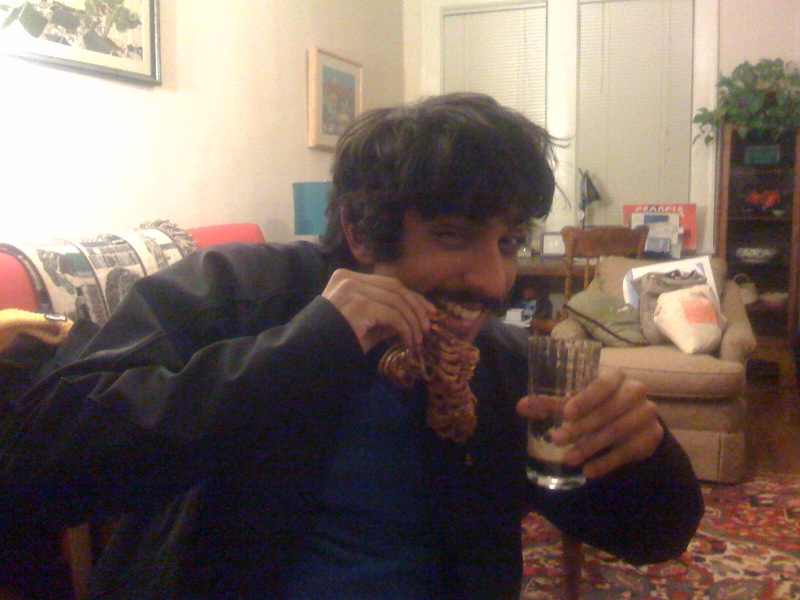
For about one half of one year now I have been included in a group of beer fans called Beer Club. We currently hold meetings every third Thursday, most often in Decatur. Though it started sparse and disorganized it has gained some semblance of purpose indicative of its members’ fervor. Now we have themes and homework. Last month was a beers of the Southeast extravaganza and overlapped with this article‘s release in the New Yorker. There was even a quiz on items in the article and the winner walked away with a one-of-a-kind pretzel and dental floss necklace (pictured). Conveniently, the November meeting also fell just after a trip to Asheville and their local beer haven Bruisin’ Ales. We stocked up on some of new favorite and anti-favorite North Carolina beers.

The idea, as I know it, is the brainchild of Ben and Katy Lovehardstein. Everyone involved brings one or two beers (one large bottle or two 12 oz of each) for everyone to try. Ben usually determines the order of tasting but based on the theme of the meeting this may vary. Everyone drinks the same beer at the same time and then votes on it. The scoring system is our own thumb down (-1), thumb level (0), thumb up (1) and then you total that beer’s score. Also everyone gets one double thumbs up (2) for the evening. I think we have tasting notes for all of our meetings somewhere but by the end of it they get lost.

Tonight is the December meeting of beer club and we’re focusing on seasonals (my suggestion for a festival of light[beer]s was offered a bit too late). Here’s the lineup so far.

Great Divide Hibernation
St. Bernardus’ Christmas Ale
Birolla Malthus Chestnut Ale
Highland Cold Mountain Winter Ale
Rogue Santa’s Private Reserve
Sammy Smith Winter Welcome
Brouwerij Huyghe – Delirium Noël
Dogfish Head Chicory Stout

Winter Lip Warmer

Over the weekend Lauren and I went to Brooklyn to visit Susan. While we were there we got caught up in a flurry of mustaches, otherwise known as Mustaches for Kids (perhaps the most disturbing name for a fundraiser ever invented). Susan’s boyfriend Jason was one of the ‘growers’ and raised money for public education. The competition extended for a month and had some strict guidelines about where and when you must shave. The Atlanta Chapter follows similar rules but donates money to a fund for childhood cancer research and prevention. In Brooklyn it culminated in a Stache Bash on Saturday with judges determining who would be king of the mustaches. They had to drink Guinness to see how much foam their mustaches could retain and also recite (or read) a haiku which they had written for the winter lip warmers or fox’s eyebrows, as it were, that now donned their faces. All in all it seems a good way to raise money while drawing attention to your cause. We’ll see if I decide to get involved next year at ‘the close of the growing season.’

Blowing it

I have an ongoing and growing beef with leaf blowers, particularly gas powered leaf blowers. One look at my yard and you’ll know that I do not have a blower, however I have used them and I have cleared my own driveway without one. My distaste for the machines stems from a belief that they cause more harm than good. When I mention the devices I get a similar reaction from most people.

The most common complaint is that the machines seem pointless. “They just move things around,” people often say. While it is true that blowing leaves will only move them from one place to another, this season I have also seen vacuum trucks moving with teams of blowers to suck up the leaves. This was on Georgia Tech’s Campus and I wondered where the leaves went. The Georgia Tech 2005 Landscape Master Plan the concepts of sustainability, eco-mimicry, and ecological succession are emphasized as objectives. As best I can tell, this would include leaving fallen leaf masses to decompose among the diverse understory shrubs promoted in the plan. Among the action items for ecological succession are

Allow under-utilized mowed areas to revert to more complex plant communities to improve the composition of the soil increase its capacity to infiltrate and manage stormwater. It will also save maintenance dollars.

and

Adjust landscape management to address ecological succession.

Allowing leaves to remain under trees and decompose in place, seems in line with those goals. Even if the vacuumed leaves are taken to a larger composting operation this doesn’t necessarily help the areas where the leaves fell. There are a number of ways to manage leaves (see link below). We were planning on mulching ours with our mower.

Recall this whole rant started in a discussion about “just moving leaves around.” This is, in fact, the case in many locations around the city; the leaves get pushed into the streets. With the leaves also goes trash and gravel and with traffic’s assistance most of it ends up sitting around the road’s outer edges. This is exactly the part of the road that bikers are confined to and the type of debris that make riding a bike less comfortable and convenient (not to mention flat tires). As a bike rider this is another reason I dislike blowers.

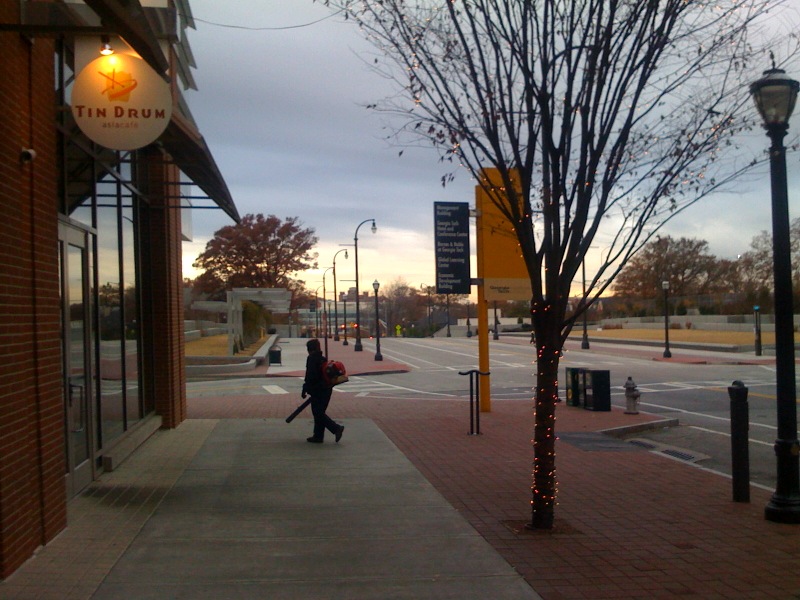
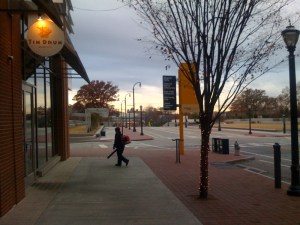
Their use with trash is disturbing and raises new questions about the definitions of litter. Though not the generators of the trash, should the landscapers be held responsible for the trash they blow from the sidewalk and into the streets? Regardless of who absorbs the blame this point begins to get at their many levels of wastefulness. If landscapers are being paid to clean up sidewalks, patios, and lawns but are only moving the debris to another location (in some cases less than 10 feet away) should they receive payment for a job well done? A more direct example of the waste the machines are responsible for is in fuel. Both gas-powered and electric blowers require some fuel inputs. Most of these are fossil fuels (gasoline, coal or natural gas power from power plants) and generate pollutants including carbon dioxide, elemental carbon and particulate matter (as well as the dust they kick up into the air). (Maybe they’re not as bad as I make it sound) The real waste of such fuel use comes from the fact that the work could also be done using a broom or rake. It must be that the cost of fuels have not gone high enough to offset the ‘efficiency’ gains in speed and volume cleared… yet. But if we’re paying people to go out and blow in settings like the one in the photo below (taken last week in the morning, there are no leaves and hardly trees anywhere) than how efficient are blowers?
Finally, how safe are the machines? Most of us who have seen blowers in action have seen operators armed with personal protective equipment (PPE). These accessories include headphones, facemasks and goggles to protect the operators from the hazard of using the machines. However, these machines operate in public spaces in close proximity to people without such PPE. Some of the hazards are obvious, debris and fumes in the respiratory tract, debris to the eyes and hearing damage. Others are less apparent but real for example the nuisance and obtrusiveness of the machines. Some may say that we’ll get used to them and learn to ignore them but I take the fact that operators will try to stop when people are walking by as proof that we have not. I think they get social pressures like dirty looks and direct instructions from bosses (landscape company owners who have received complaints) to use such caution around people.

I have raised several questions about blowers here to which I assume you know how I would answer. I am interested to hear your comments and thought about blowers. Bans on blowers represent a possible slippery slope and could take away mowers and things that I use but could be a step in the right direction. It’s also important to consider that there are much bigger problems on which to devote our time and energy.

Leaf Management Suggestions

A California town’s blower opposition

California Air Resources Board Report on Blowers

Some people (landscapers) hate blower bans

For Best Results

I have one more final to finish and then I can move on to other things (like more blogging). This last final is in Regional Economic Foundations of Planning which is roughly about spatial economics. A main theme of the course is the interpretation of growth vs. development. Stereotypically, the semantics of economics are fairly stringent. Costs and benefits refer only to those things on which you can put a price or which the market puts a price on. I mention it to introduce this brief post and say that semantics are a funny, subjective thing. (and, I guess, thus economics could be subjective and funny, maybe)

Anyway, this is my toothpaste. Excuse the poor quality of the photo. I looked at it the other morning and noticed that it said “For best results, squeeze tube from the bottom and flatten as you go up.” Lauren and I have been doing this accordion style for weeks and our teeth have never been cleaner.

Clover

Over a month since I posted and I’m comin’ up for air. Taking a break from work and such for a night and trying to put together a post. Since last writing my family has visited, I went to Boone for a bouldering competition and just got back from San Diego for the American Public Health Association’s annual meeting. It was my first time really staying in San Diego and, like everyone, I was attracted to its beauty and weather. However, I feel like that’s what makes it for San Diego. While it feels Californian, I don’t think it has that unique identity that San Francisco and Los Angelos each claim for themselves. There was a lot of getting around by skateboard though, and I always find that cool.

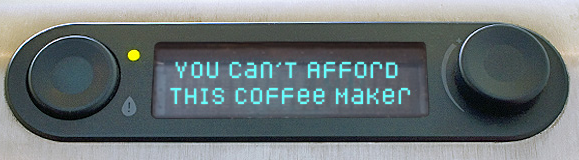
Also cool was the fact that Chad came down from Santa Barbara to hang out for a day. We watched Michigan football (lose), talked about iPhone apps and explored the environs. When looking for coffee, he brought up the Clover. I had no idea what this was but Chad’s enthusiasm about the device (or the coffee) was enough to capture my interest. Chad just finished his PhD in materials science and engineering. As you might expect that means a lot of time spent in the lab with other compatriots. This also means lots of coffee. Chad’s group used thermal couples around the lab to control the temperature of water for brewing in their French press. Leave it to engineers to take coffee precision to new decimal places. The Clover was designed by Stanford mechanical engineers with the perfect cup of drip coffee in mind. Chad’s mention of the machine planted the Clover seed in my head, now we had to find it.

The machine costs around $11,000 and makes only one cup of coffee at a time. But to call it one cup of coffee is an injustice. I found a coffee and tea shop near our hostel and not knowing the level of coffee snob-dom that the Clover represented I suggested we go there to look for it. The place had knick-knacks from countries that grow coffee and a regular espresso machine (ho-hum). However at the mere mention of the Clover they immediately pointed us in the right direction. There may only be one place in all of San Diego with one of these coffee brewers but the legend of it was obviously pervasive. We were off to Caffe Care Diem.

We weren’t after this thing Amazing Race style, the Clover is a cultist (cup of coffee could be over $5) thing and we knew it would be there later waiting for us. So we meandered over to Coronado and to the beach. Later when we wanted some coffee – that’s when we started after the Clover. The Carpe Diem we went to was the wrong one, however. Once again I marveled at the way the servers responded to our inquiries about the Clover. It was almost mythical. Everyone knew what we were looking for and had heard about its presence in the greater Metropolitan San Diego Region. Our patience again prevailed and we took our regular coffees with us as we checked out the park.

Chad had some work to do later that night and did not want to start back too late to SB, but we had one thing to do. Drink the Clover. We found the shop and prepared for our experience. Upon initiating the Clover process I immediately knew that I was in over my head. I do not consider myself a connoisseur of anything and know I was choosing the beans that I would be drinking at their fullest potential in just 5 minutes. The barista’s knowledge, on the other hand, was intimidating. I got sentimental and chose Colombia. Upon serving she noted the what the roast was known for and what to look for as it cooled. I tensed up about adding anything to the brew and took it black. And here’s the rub, you really need to have beans of adequate quality to justify such a luxury. Also, you need to know your coffee.

As with other gourmet and ‘fancy’ experiences of the pallet I think half of it is the ceremony and for that, the Clover is worth the hype. The machine is sleek and study, and the attention I was given with my order was nice as well. The Clover is also connected to the internet so that the temperature and time of the brew for your bean of choice is guaranteed to be spot on. Since returning to Atlanta I have looked for, and found, a Clover near me. Not surprisingly, it’s at Batdorf & Bronson and of course in Decatur. I am not sure how much I will indulge myself with the Clover, but at least I know it’s there. The company was recently purchased by Starbucks, so look for it near you.

The Clover Website
How the Clover works
Video of the Clover

It’s the Environment, Stupid!

All this political hype of the last few weeks has me sick of hearing about the environment. Everybody now feels obligated to mention it in speeches. One particular phase of note is “energy independence.” I guess that started with W’s State of the Union several years ago but now it’s a mandatory mention in any stump speech. I give credit to gas prices. I also hear a lot about drilling. Masses of people demanding, or at least strongly supporting, drilling. It seems like a non-issue. Drilling is going to happen and not much will change, but today the house voted to ease the ban on offshore drilling (and without a new president). Of course those tree-hugging Democrats still left the best prospects off limits and snuck in legislation to investigate sources of energy other than oil. Now tell me, how is that gonna reduce our dependence on oil?.

Getting away from all of the politics and the ubiquitous discussion of issues I still find myself inundated with the environment. It’s like the environment is all around me. Green is the new ‘zero carbs’ in a world where I have to take the bus, rapidly renew things, and shut off lights. Even in chocolate you can find the green marketing trying to move product that was probably shipped to the point of consumption from more than 1,000 miles away.

Lauren and I recently went to Serenbe for an anniversary weekend of relaxation, but everywhere we looked we ran into groups of recycling locavores. This place was half farm, half art fair and all green. For the sake of our psyches I can only hope the fervor of their Earth-friendliness is not sustainable.

This type of constant messaging on the greenness of things is getting to some people. It could drive us all crazy soon. Take for instance the video below. The woman in the video probably saw a Brita commercial on tv, heard how much energy goes into bottled water, read the words “metal oxide salt” somewhere, considered fears of shifting water supplies from “global warming” and was trying to put it all together with the latest news on BPA.

get unstupid

Michael Phelps

Had mad trouble falling asleep last night and then had this dream I was in this car and Michael Phelps was driving (I think Braylon Edwards was in the back seat) and we were getting on a ferry but you had to drive on all these curvy docks. I was scared because I thought he was gonna drive off of them a few times and he kept talking to us and not paying attention. But of course we didn’t say anything because he was Micheal Phelps. Then he did and we were in the water and I had to resign to the fact that I was going to die even though I thought he would find a way to swim out of it and then found it really ironic that this is how he would die. I jumped out of my sleep and it was only 2-something.

What does this mean?

I am comfortable with being confronted with death?

I think I have a bond with Phelps and Edwards because they are buddies since they were in Ann Arbor and I feel like I’m in their crowd?

I have an irrational fear of driving on narrow docks over the ocean?