Category: Uncategorized
April 7, 2010

Today is World Health Day 2010. The theme for this year’s World Health Day is ‘Urban Health Matters’ (focused on urbanization and health). As part of the efforts to raise awareness about the day, the WHO is recruiting cities from all over the world to be part of its 1000 Cities, 1000 Lives campaign. Atlanta is represented among 1000 cities because it is opening its streets to the public as part of an event in May called Atlanta Streets Alive. If you’re in town please be sure to check out the event. If yo’re not in the area, chances are you live in an urban area. Visit the WHO site to find out something new about urban health, what’s going on in your city and how you can make your city healthier.
Social Capital Survey
County Health Rankings
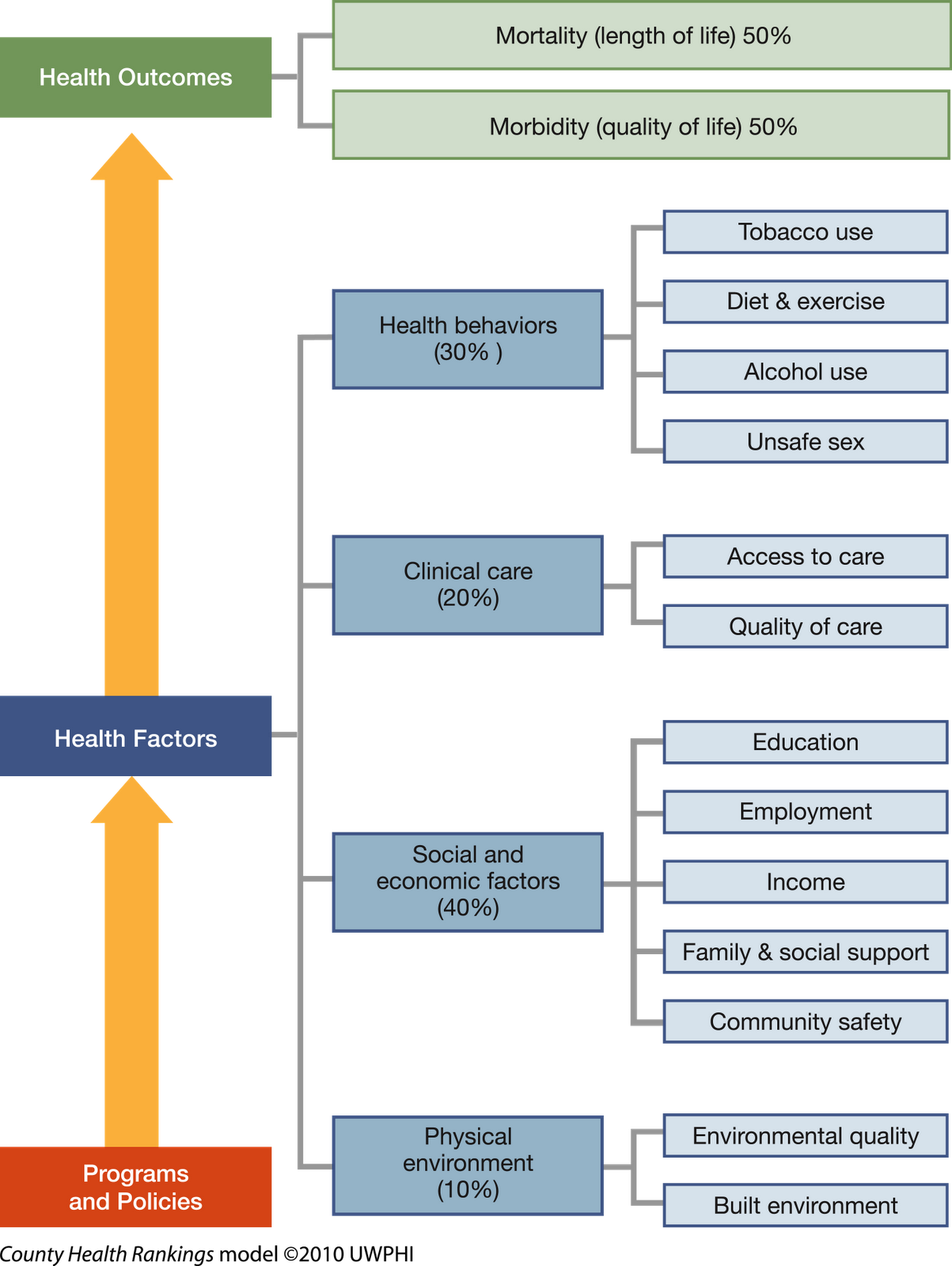 A couple months ago a listing of county health rankings was released. It was funding by the Robert-Wood Johnson Foundation and housed at the University of Wisconsin. It offers rankings for all the counties of a state based on one of two composite metrics: health outcomes and health factors. Outcomes focus on morbidity and mortality while factors consider social, environmental, and access components (see diagram). You can look at the data on any of the inputs for a single county.
The rankings compare only counties in a single state. So we can look at the counties that are relatively healthy in Georgia but they are not directly comparable to counties in the next state. They are based on America’s Health Rankings which does similar things to rank states. They factors included are meant to represent those which, if improved, will make that place healthier. You can use them to look at distributions within a state and begin to draw conclusions that way. Then you can compare those trends to other states. For example in Georgia you can see that the counties around the urban center (Atlanta) have relatively high health rankings compared to the rest of the state (Fulton and Dekalb are 24 and 17 of 157). However, for Michigan you can see that the urban counties are relatively unhealthy compared to the rest of the state (Wayne is 81 of 82). A comparison of the 50 healthiest and unhealthiest(?) counties in the country examined this question a bit more closely. They found:
healthier counties are urban/suburban, whereas least health counties are mostly rural. About half (48%) of the 50 healthiest counties are urban or suburban counties, whereas most (84%) of the 50 least healthy counties are rural. 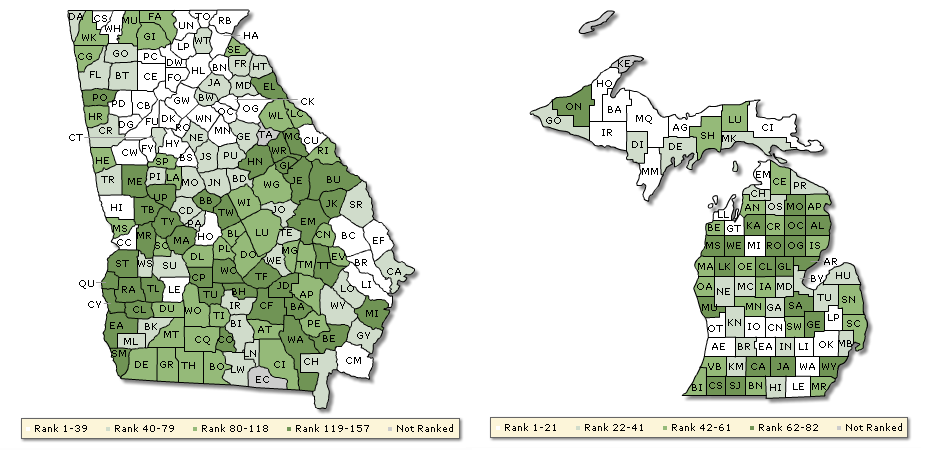 In order to take advantage of the data and compare counties in different states I decided to take a limited sample of counties (ones where I have spent a fair amount of time) and look at them more closely and with respect to some easily obtained demographic data from the 2000 Census. The results are shown below. I need to do a little more digging in the data, but I hope to use this as a pilot study and to try and get the stats for a larger percentage of counties all over the country to look at this data.
Alone in the Wilderness
This week on GPB they aired a program call Alone in the Wilderness. It follows, or rather presents, the life of Dick Proenneke, or rather his later life. After retiring at 50 he went to Twin Lakes in Alaska where he built his own cabin in the wilderness. The film follows that first year building the cabin and then braving his first winter. Dick filmed it all himself and kept detailed diaries. He lived there for over 20 years.
The footage of the animals and and the landscapes are nice but seeing him work the wood and construct his foundation, frame, roof, door, fireplace, sled, and more is really interesting. The man can saw and work with an axe. An excerpt is included below, and the whole thing can be seen on a few Chinese sites through Google.
Repurposed Furniture
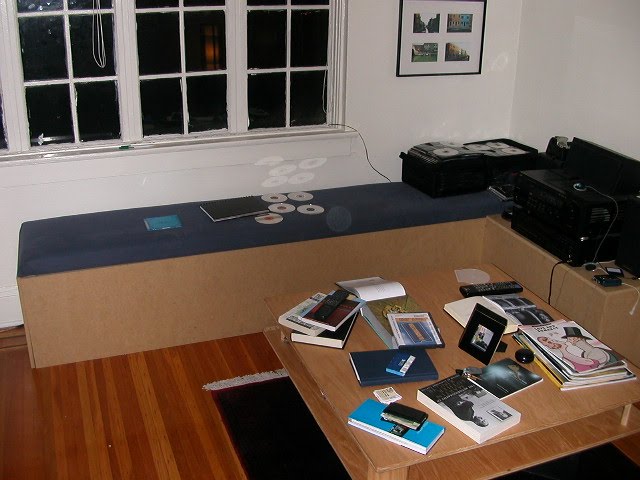 After leaving San Francisco and before moving to Louisville, Kentucky for a job in August 2002 I had about a month to spend in Detroit kill free time. One thing that I did was buy a notebook with unlined paper (I thought I was so cool) and begin to draw sketches of furniture. In college I had assembled a simple rectangle made with 2″ think boards of wood to hold a tv in our apartment. It was remedial and didn’t have much forethought. Plus it only involved a few screws after cuts were made. In the notebook I was trying to think about the design prior to building. Plus this time I would have to buy wood, so considerations for cuts had to be taken. What I made, with the help of some family pals, was a two layer coffee table. It was an awkward size (3’x3′) and the best part of it was the top. For legs I used two rectangles of plywood painted black that fit together and could be placed inside the table during transport and storage. Well for the last 3 years it’s been in storage, residing in a lonely slot of space next to our fridge and only coming out for the occasional deck parties. I think the dimensions of it were its detriment in our new house.
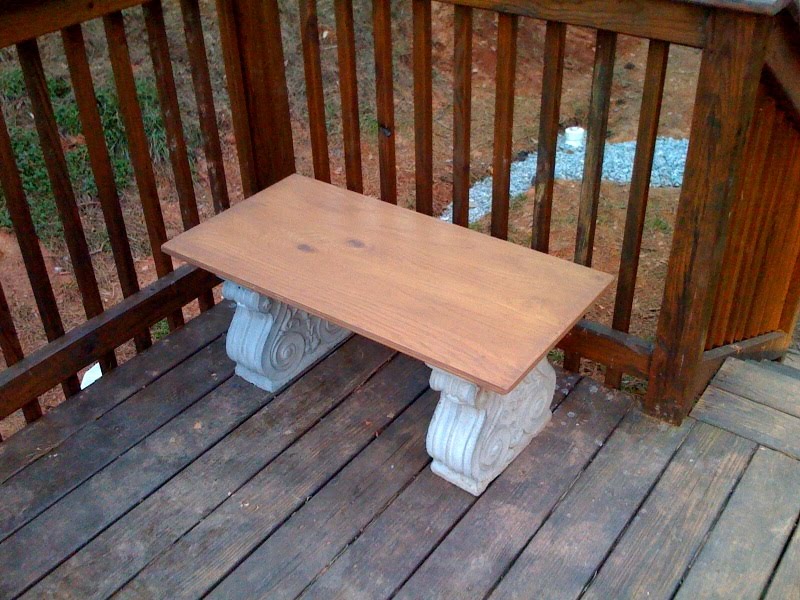
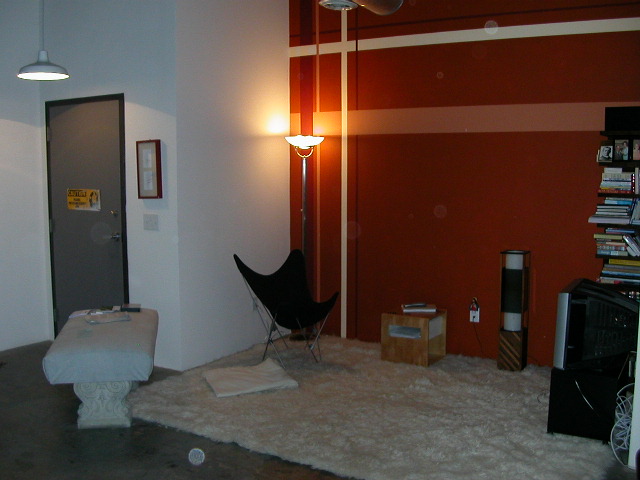 In what seems to be a trend in this house, another piece that I made also never really found a home. It was a bench that I made using salvaged couch cushions found on the side of Briarcliff Rd. in 2004 during a visit to Atlanta. While I kept designing and making furniture in Louisville one thing I tangentially learned was upholstery. I cleaned up the cushions and added some a new skin but once again the legs seemed to be a problem. It started out with 6 post legs that wobbled often and eventually Lauren and I found a Home Depot willing to sell us just the two podium legs of a cement garden bench. This made for a sturdier, though more difficult to move, bench for our space. After moving from place to place throughout our house it was disassembled recently. Many of the boards went on to provide planks in the attic and the legs finally made it outside to be used near a garden, though without a bench.
 Like the bench the coffee table also finally met its demise. It sat out on the street for a day and a half with a sign that said “Free to a good home.” Then I defiantly went down, grabbed it, and brought it back up to the house; set on improving it to a state worthy of a permanent spot on our deck. My initial intention was to refinish the whole thing for outside use and find some new legs. But then I took it apart, cut the bottom layer in half, and finished it and the top separately. I used the half to make a bench top for the cement bench feet we had and with some new legs the original table top is now a stand alone table for the deck. I still have have a table to spare. I wonder what we’ll come up with for it.
At least one piece of furniture that I made still exists in its original state (two actually): the cube end table with the built-in magazine rack seen on the shag rug in the picture above. However, I can’t claim credit for the design. I saw in at a furniture boutique outside a farmer’s market in Santa Monica.
Tonight
This is the next night, no joke. I could make a page-a-day calendar of these. A very peaceful page-a-day calendar that makes you fall asleep.
Evenings at my House

Shot Down
During my senior year at Michigan I had the chance to serve on the undergraduate student governing body as a representative of the College of Engineering. I was thrown into a diverse group of students with cultural and political knowledge far greater than my own and we were seen to represent both the student and the local population. I was in way over my head but I think it opened my eyes and I learned a lot. Unfortunately for the student body I think I got more out of it than they did. We were expected to come out with statements of solidarity with student religious groups, and this was during the University’s big affirmative action cases so we were coming out with statements about that too and organizing bus loads of people to go down to Detroit to the courts for the case.
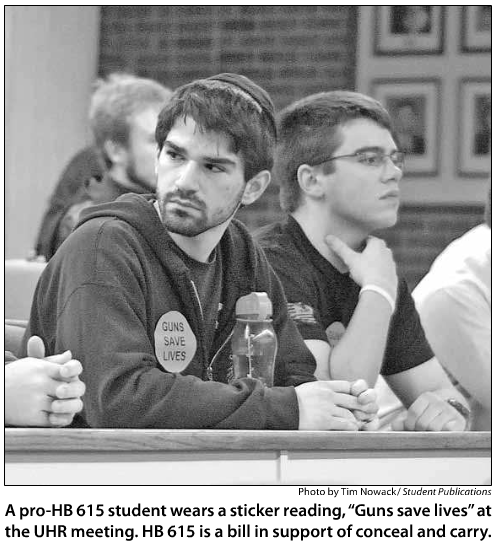 This week the undergrad governing body at Tech was also making some big decisions. (Note the all too common irony of religion and gun support) Specifically, they were deciding whether or not to approve a conceal and carry law for students on campus. This would allow students over 21 who have appeared before a probate courts and undergone a background check to legally carry a gun on campus. The student governing body initially put forth a survey to the student body and just over 50% of students opposed the measure.
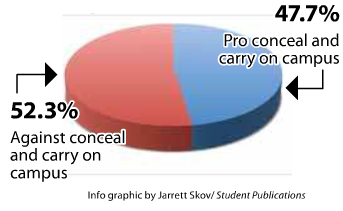 Though I agree with this verdict, the numbers are worrying. The student representatives are in a tough position where they may feel morally opposed to guns but responsible to their constituency. Personally, I don’t think the university is the place for people to be carrying concealed weapons. It is sometimes as much a place for growing to realize your personal responsibilities as it is for gaining new book knowledge and skills. Allowing guns does not help with this. It is difficult enough without introducing 1. the responsibility of owning and carrying a lethal weapon around or 2. the possibly frenetic social experience of thinking your peers may be carrying guns. Not to sound snooty about it but, for the most part, this University is a pretty self contained unit. Although it’s in the heart of a city, there is not a lot of intrusion from the periphery. When you walk around you have a pretty good idea of who the students are, who is sketchy, and who should be carrying weapons (the police). And I think compared to most of the City, there are a lot of cops on campus.
Aside for this Tech ruling, I have been seeing a lot in the news around town about guns lately. Chicago’s gun ban just got shot down by the Supreme Court. Unofficial Tea Party ‘leader’, former Alaska governor, and likely future reality TV show participant Sarah Palin is about to give the keynote address at the NRA’s national meeting. Also, here is a recent episode of This American Life themed on guns, check it out and let me know what you think about guns.
post script found this table while doing some research for something else. It’s about risk perception and ranks them against each other. It includes handguns so I thought I would throw it up here. It’s from Slovic, P. 1987 Science. Vol. 236 no. 4799. p.280-285.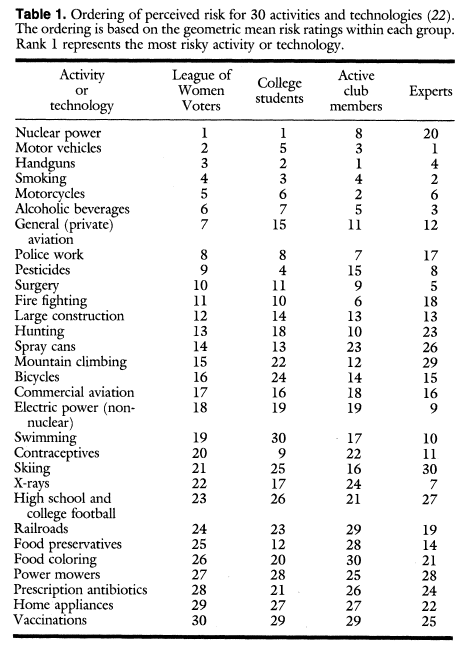
MARTA’s Yellow Line
 Recently a stink has been made about the name given to the MARTA Rail Line formally known as Doraville. The dispute came about from business owners and community members along the northeast line of Asian ethnicity. They were a bit peeved about MARTA labeling the line “The Yellow Line.” The yellow distinction was considered racist and MARTA agreed to change the name of the line to gold. This facilitated the use of existing maps while quashing the beef.
This whole dispute made me think, is that really the yellow line? I think that section of town is more Asian than most but is it majority Asian. I created a mp of the MARTA rail system that reflects the composition of the communities surrounding each stop. I looked at proportion of white, black, Latino, and Asian populations from the 2000 census, using all the census tracts within a mile of each stop. This doesn’t account for the local business ownership but should give us an idea of which line is yellow or black or white or what have you. It looks like the stops along the gold line have more Asian residents around them than other stops but the majority of people around those stops are of another race (specifically Latino around Doraville and Chamblee). I also looked at populations for only the census tract in which the station fell. The results were similar with fewer Asian proportions at almost every station. At the Lindbergh Station the 1 tract method showed 63% of the population as Latino, while including the surrounding tracts introduced an overwhelming number of white residents.
Secondly, how could the community find a way to embrace this? I have had several conversations with Asian friends who grew up in western countries about who was an egg and who was a banana. Maybe you’ve talked about twinkies. Tourists in New York, San Francisco, and other cities around the world seek out their Chinatowns for a meal and some souvenirs. DC has a metro stop called Chinatown. At the same time the best examples of those places support a large Asian population that can go about daily shopping activities or find a Majong game. Maybe we should call it La Linea to nod to the Latino populations up there. Still I think formalizing it on documents and websites makes it sting and stirs up the opposition. When it’s a colloquial thing like Curry Hill in NYC, does the same opposition present itself? And if it does, at whom is it directed?
I’m interested to hear more of your thoughts on this and on the map. Thanks.
 VARGOCITY